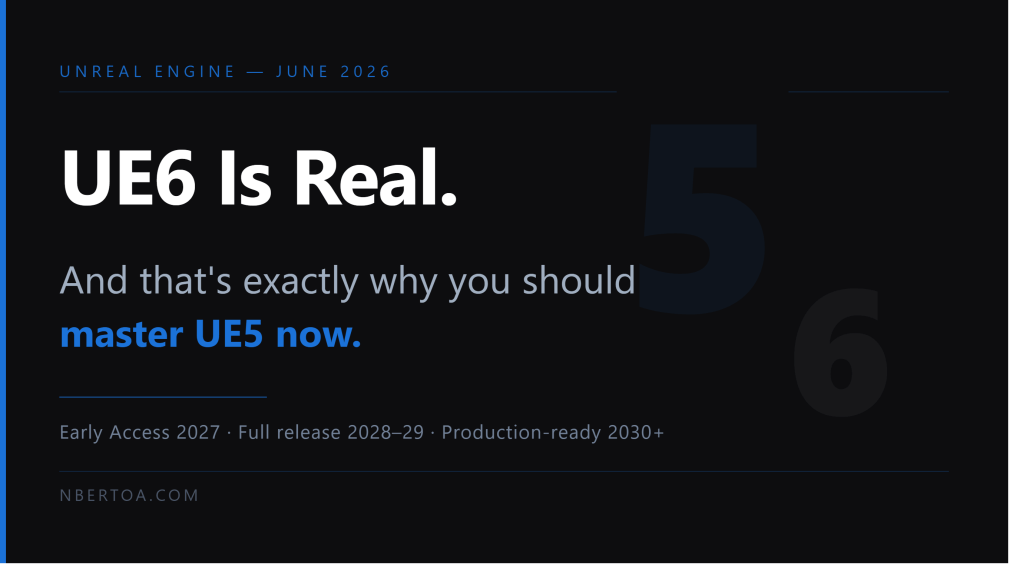
On June 17, 2026, Epic Games held the State of Unreal at Unreal Fest Chicago. They officially confirmed Unreal Engine 6 — its goals, its architecture, and a rough timeline. Within hours, the same question started appearing across Discord servers, Reddit threads, and Slack channels everywhere: “Should I stop what I’m doing and wait for UE6?”
The short answer is no. The longer answer is why — and it’s grounded in data, not speculation.
We’ve Been Here Before: The UE4 → UE5 Story
To understand what’s coming, it helps to remember what already happened.
Unreal Engine 5 was first revealed in May 2020 with that iconic Lumen in the Land of Nanite demo running on a PlayStation 5. It was breathtaking. It was also two years away from being usable. UE5 reached Early Access in May 2021, and its official full release came in April 2022 — nearly two years after the announcement that made everyone stop and stare.
But here’s what actually happened in studios during that time: almost nothing changed. Projects that were in production on UE4 kept going on UE4. The Marketplace ecosystem — plugins, assets, code libraries — took well over a year after the UE5 release to meaningfully catch up. Early UE5.0 had real limitations: Nanite didn’t support translucent materials, Lumen had serious performance constraints on consoles, and many third-party plugins simply didn’t compile yet. The UE5 that developers actually trust for production today — stable, feature-complete, with a mature plugin ecosystem — is UE5.3, 5.4, 5.5 and beyond. That maturity arrived in 2023 and 2024, roughly three to four years after the initial announcement.
Meanwhile, UE4 didn’t disappear. Games shipped on UE4 throughout 2022 and 2023 without any issues. Third-party SDK support for UE4 only began winding down gradually — Meta, for example, made its last feature update for UE4 in 2022 and issued its final patch in June 2023, more than a year after UE5 launched. The transition was slow, deliberate, and completely manageable for teams that had planned their projects around UE4.
That’s the pattern. Announcement → Early Access → Full Release → Ecosystem maturity. Each step takes longer than the excitement of the announcement suggests.
The Real UE6 Timeline
Now apply that pattern to UE6.
Epic confirmed at the State of Unreal on June 17, 2026, that they are targeting an Early Access release for UE6 at the end of 2027. The full release would follow approximately 12 to 18 months after that — putting a stable UE6 somewhere between late 2028 and mid-2029. (Source: Epic Games — State of Unreal 2026)
But remember the lesson from UE5: Early Access is not production-ready. It’s a preview for experimentation and feedback, not a foundation for shipping a game. If the UE4→UE5 transition is any guide, the first version of UE6 that a studio could reasonably build a full game on — with a mature plugin ecosystem, stable APIs, and proven tooling — is probably UE6.2 or UE6.3. Based on Epic’s historical cadence of roughly two to three major point releases per year, that puts a genuinely production-ready UE6 at 2030, at the earliest.
That means UE5 has a conservative minimum lifespan of four more years as the industry-standard production engine. And that estimate is optimistic — AAA studios, which drive much of the ecosystem, typically move even more slowly.
How Long Will UE5 Stay Relevant — And When Is UE6 Actually Ready to Ship a Game?
Let’s be concrete about this, because vague reassurances aren’t useful.
UE5 is currently on version 5.8, released in June 2026. Epic confirmed at the State of Unreal that 5.8 is the last planned major release for UE5, though they reserved the option to ship a 5.9 if needed. (Source: Epic Games — State of Unreal 2026) That means UE5 is not being abandoned — it’s being finished. It will continue receiving security patches and critical fixes. Studios will be able to ship games on UE5 without interruption for years.
Here’s a realistic breakdown of the UE6 adoption timeline:
- Late 2027 — UE6 Early Access: Useful for experimentation and learning Verse. Not suitable for production game development. Plugin ecosystem will be minimal.
- Late 2028 to early 2029 — UE6 Full Release: Core engine is stable. Early adopters and small indie developers may start greenfield projects. Most Marketplace plugins will still not have migrated.
- 2030 — First realistic window for indie production on UE6: Ecosystem has had time to catch up. Third-party plugins are available. Documentation is mature. This is when it starts making sense to begin a new project on UE6 rather than UE5.
- 2031 and beyond — AAA production on UE6: Large studios move slowly by necessity. The first AAA games built from scratch on UE6 will likely ship in this window.
The single best indicator to watch is not the engine version number — it’s the plugin ecosystem. When major plugins like Gameplay Ability System extensions, procedural generation tools, and AI behavior frameworks have stable UE6 releases, that’s the real signal that the platform is ready.
What UE6 Actually Changes
Understanding what UE6 changes matters, because it tells you what current skills transfer and what will eventually need to be relearned.
The three major architectural shifts Epic announced are:
- Verse replaces C++ as the primary gameplay programming language. Verse is a new language built by Epic, designed with transactional memory semantics — meaning all gameplay functions run as atomic transactions that can be rolled back and re-simulated. It draws from functional, logic, and imperative paradigms, and Epic describes it as feeling familiar to anyone who has worked with Python or C#. Importantly, C++ doesn’t disappear — Verse calls C++ code underneath via a custom LLVM compiler that automatically “transactionalizes” it. (Source: Epic Games — The Road to UE6)
- Scene Graph replaces the Actor/Component framework. UE6 introduces an entirely new gameplay framework built from scratch on Verse. The familiar Actor, Component, and Pawn model that UE4 and UE5 developers know will eventually be deprecated. Epic confirmed that Actors and Blueprints will still be present in early UE6 versions, with conversion tools provided when the new framework is mature enough. (Source: 80.lv — UE6 Unified Engine)
- UE5 and UEFN merge into a single engine. The separate development tracks for standalone games (UE5) and Fortnite creator content (Unreal Editor for Fortnite) are converging into one unified platform. The goal is that content, code, and economies can become portable and interoperable across games and ecosystems. (Source: Epic Games — State of Unreal 2026)
What UE6 Does NOT Change — At Least Not Yet
This is the part that matters most for anyone building something today.
Epic was explicit about their migration philosophy: “Our approach through this transition is to bring existing projects along, not to force a hard break. Studios shipping on UE5 today should expect a manageable and clear path forward when UE6 is ready for them.” (Source: 80.lv — UE6 Unified Engine)
Concretely, this means:
- Actors and Blueprints will be present in the early versions of UE6. They are not being removed on day one.
- C++ remains the engine’s underlying language. The entire rendering pipeline, physics, audio, and editor systems are still C++. Verse sits on top of C++, it does not replace it at the engine level.
- The rendering technology — Nanite, Lumen, MegaLights — continues to evolve within UE5 and carries forward into UE6. UE5.8 itself introduces Lumen support for Nintendo Switch 2 at 60fps. The rendering track is continuous, not a reset.
- Core Unreal concepts — world composition, asset management, the Editor itself, Enhanced Input, animation systems — transfer directly. The learning investment in these systems is not wasted.
The Ecosystem Problem
One aspect that rarely gets discussed in engine transition conversations is the ecosystem — and it’s arguably the most important practical consideration.
When Epic ships UE6 Early Access in late 2027, the Unreal Marketplace and the broader plugin ecosystem will not be ready. This is not speculation; it’s what happened with every previous transition. When UE5 launched in April 2022, the majority of established plugins were still UE4-only. Developers who needed specific tools — advanced AI behavior systems, procedural generation frameworks, networking solutions — either had to wait for plugin authors to migrate, port the plugins themselves, or build alternatives from scratch.
Plugin authors face a real business problem: they can’t invest months of work migrating to a new engine version until there’s a sufficiently large user base on that version. And there won’t be a large user base until the plugins are there. This chicken-and-egg dynamic is why ecosystem maturity always lags behind engine releases by one to two years, even when the engine itself is technically solid.
For anyone building a game — indie or AAA — the plugin ecosystem is a critical dependency. A missing plugin can mean months of extra development work. This alone is a strong argument for not chasing the Early Access release of UE6.
“But Won’t AI Just Accelerate Everything?”
This is a fair and honest question — and it deserves a direct answer rather than a dismissal.
Epic has already confirmed AI integration at the engine level. UE5.8 introduces an experimental MCP plugin that allows models like Claude, Gemini, and others to connect directly to Unreal Engine projects — not as copy-paste assistants, but as active collaborators that understand and operate within specific engine workflows. UE6 is being built with these integrations as a core part of the development pipeline. (Source: Epic Games — State of Unreal 2026)
So yes, AI will accelerate certain things. The question is which things — and that distinction matters enormously.
AI accelerates the speed of writing code. The bottlenecks in UE6 adoption are not about writing speed. They are about four fundamentally different problems:
- API instability during Early Access. During the first year or two of a major engine release, APIs change between point versions. An AI model trained on UE5 will generate UE5 code. An AI trained on UE6 Early Access will generate code that may be obsolete by the next point release. No amount of generation speed fixes an unstable target.
- Missing plugins. No AI model can write you a battle-tested networking plugin, a mature physics simulation framework, or a production-grade procedural generation system in an afternoon. Those tools represent years of development, edge case handling, and community validation. When they don’t exist for UE6, AI cannot conjure them — it can only help you start building from scratch, which still takes months.
- Architectural judgment. AI amplifies existing knowledge — it does not replace it. A senior developer with AI assistance is exponentially more productive. A developer without a solid understanding of Unreal’s architecture who relies on AI-generated code will produce bugs faster, not games faster. Evaluating whether generated code is correct, performant, and architecturally sound requires deep engine knowledge. That knowledge only comes from experience.
- Verse has no training corpus yet. The transactional memory model at the heart of Verse — rollbacks, re-simulation, distributed state — is conceptually new. There is no large body of production Verse code for AI models to learn from. The models will catch up, but that takes time after the language matures and developers start publishing real projects built with it.
The honest conclusion: AI will likely shorten the UE6 ecosystem maturity curve somewhat — perhaps by months rather than years. But it doesn’t change the fundamental argument. The bottlenecks are platform stability, ecosystem depth, and architectural knowledge. Those three problems are not solved by faster code generation.
The Career Argument: Why Mastering UE5 Now Is the Fastest Path to UE6
This might sound counterintuitive, but it’s the most important strategic point in this article.
The foundational knowledge of Unreal Engine — how the Editor works, how assets are managed, how the rendering pipeline thinks, how multiplayer replication is structured, how animation state machines are organized — does not change between UE5 and UE6. Epic’s own documentation confirms that C++ programming APIs are expanded in UE6, not replaced. Blueprint visual scripting follows the same paradigm, extended with Verse integration. The skills that take the longest to develop — architectural thinking, performance intuition, debugging methodology — are entirely transferable.
The developers who will have the easiest time with UE6 are not the ones who wait for it. They’re the ones who spend the next three years going deep on UE5: understanding its subsystems, shipping projects, hitting real performance problems and solving them, learning to read the engine’s source code. When UE6 arrives, those developers will have the mental model already in place. Verse will be a new syntax on top of concepts they already understand. Scene Graph will be a new framework for patterns they’ve already internalized.
The developers who wait for UE6 will face the same learning curve, but starting from scratch — with a less mature engine, a thinner ecosystem, and no shipping experience to draw from.
Concrete Recommendations
Based on everything above, here’s what makes sense depending on where you are:
- If you’re currently building a game on UE5: Finish it. UE5 is production-ready, mature, and will be fully supported for years. There is no technical or commercial reason to stop or migrate.
- If you’re starting a new project in 2026 or 2027: Start it on UE5. UE6 Early Access is not a viable production foundation. The plugin ecosystem won’t be there. The APIs will still be in flux.
- If you’re learning Unreal Engine today: Learn UE5, specifically C++ and the core engine architecture. Everything you learn transfers. Don’t wait for UE6 to start — you’d be waiting until at least 2030 for a production-ready platform.
- What to monitor in 2027: When UE6 Early Access drops, the right response is to install it, experiment with Verse, and understand Scene Graph conceptually. Treat it as professional development, not a production migration.
- When to evaluate a real migration: Watch the Marketplace. When the plugins your project depends on have stable UE6 releases, and when Epic has shipped at least two post-Early-Access point releases, that’s the signal to seriously evaluate migrating new projects to UE6. That window is realistically 2030.
The Developer Who Wins the Transition
Every major engine transition produces two types of developers: those who chase the new version the moment it’s available, and those who build deep expertise on the current version and arrive at the new one with experience and judgment already developed.
The second group consistently wins. Not because they’re slow to adopt — but because they show up to the new platform knowing how to build things that work, how to debug problems that aren’t in the documentation yet, and how to make architectural decisions under uncertainty.
UE6 is real. It’s coming. And the best thing you can do about it right now is become as good as possible at UE5.
Sources: Epic Games — State of Unreal 2026 · Epic Games — The Road to UE6 · 80.lv — UE6 Unified Engine announcement · Game Developer — UE6 merge announcement
 Nicolás Bertoa
Leave a comment