In this post from Lighting Series, we are going to talk about Radiant Energy and Radiant Power. The previous post in this series is Lighting Series Part 1 – Light and Radiometry. In the next post, we are going to talk about radiance.
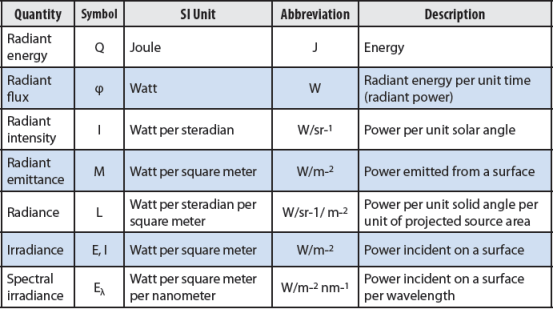
The SI System (Système International d’unites) defines six radiometric units used for describing the radiation coupling between a light source and an optical system. The most commonly used units are: Radiant Flux, Irradiance, and Radiance.
What is light energy?
In geometric optics, a convenient mental model is to think of light as being literally a flow of particles or photons. Each particle is a point that has a direction and a wavelength associated with it.
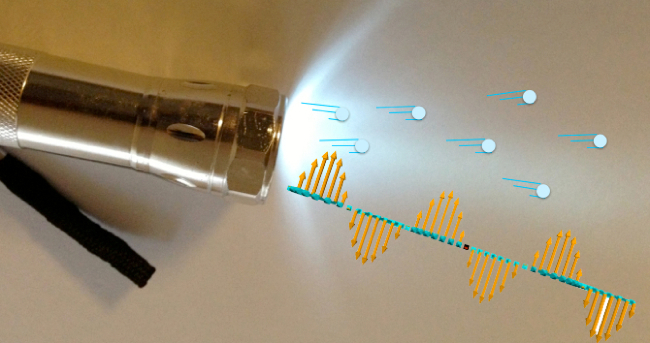
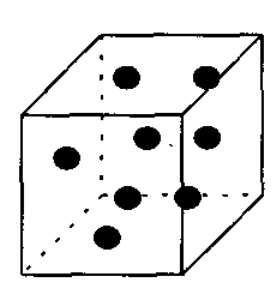
The particle density p(x) is the number of particles per unit volume at the point x. The total number of particles, P(x), in a small differential volume dV is P(x) = p(x) * dV
Example of particles in a differential volume:
Suppose we have a stream of particles that move with the same velocity vector v which has the speed of light, and we want to know the number of particles that cross a differential surface element dA in a slice of time dt.
In time dt, each particle moves a distance v * dt. If we sweep dA a distance v * dt in the direction -v, a tube will be formed. All particles that cross dA between t and t + dt must have initially been inside this tube at time t.
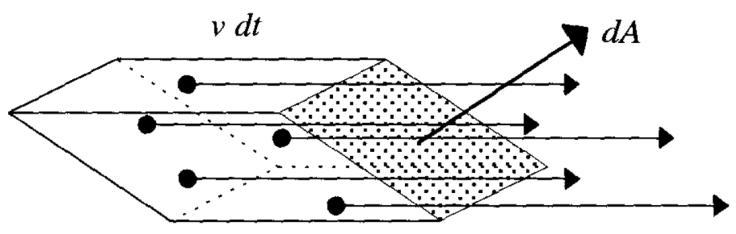
We can compute the number of particles crossing the surface element by multiplying the particle volume density times the volume of the tube. The volume of the tube is equal to its base (dA) times its height (v * cos Θ * dt), where cos Θ is the cosine of the angle between the surface normal and the flow direction.
Finally, the total number of particles crossing the surface is
P(x) = p(x) * dV = p(x) * v * cos Θ * dA
Important things:
- The number of particles flowing through a surface element depends on both the area of the surface element and its orientation relative to the flow.
- The flow across a surface depends on the cosine of the angle of incidence between the surface normal and the direction of the flow.
- The number of particles flowing is proportional both to dA and to dt used to tally the particle count.
The particle count represents an amount of energy. In radiometry, the basic unit is energy or radiant energy Q, measured in Joules (abbreviated J). Each photon has some amount of radiant energy that is proportional to its frequency. What radiometry is about is measuring the energy in different regions of space, direction, and time.
What is radiant flux?
If we divide the number of particles by the time interval dt and the surface area dA and take the limit as these quantities go to zero, we will get a quantity called power, flux or radiant flux.
Power, Flux or Radiant Flux (P or Φ, measured in watts W = J / s) is the quantity of energy emitted by an object per unit of time in all directions or received by an object per unit of time from all directions. It can be found by taking the limit of differential energy per differential time. It is the rate of increase of enegy as you sit and let light fall on your detector.
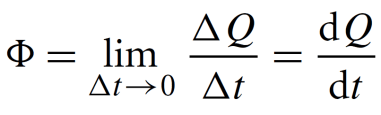
It is useful to estimate a rate of energy production for light sources. Flux does not specify the size of the light source or the receiver, nor does it include a specification of the distance between the light source and the receiver.
In computer graphics, we usually assume the scene is in steady state because the speed of light is so fast that it immediately attains equilibrium. For example, if you turn on a light switch, then the environment immediately changes from a state involving no light to a state in which it is bathed of light. Given this, light power and energy usually may be interchangeably.
Examples of Radiant Energy and Flux
Radiant Energy
In the following picture, the bottom scale shows photon energy in electron-volts. This is the amount of energy required to move a single electron over an electrical potential difference of one volt.
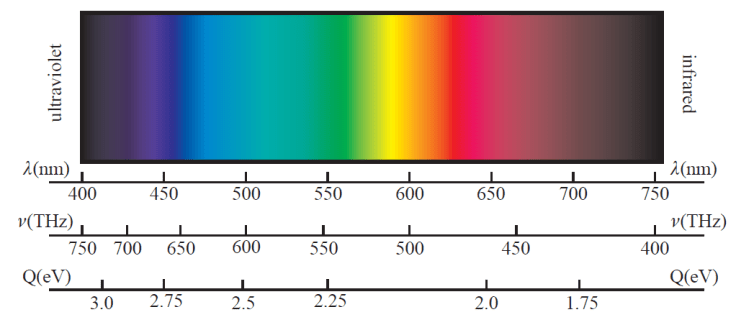
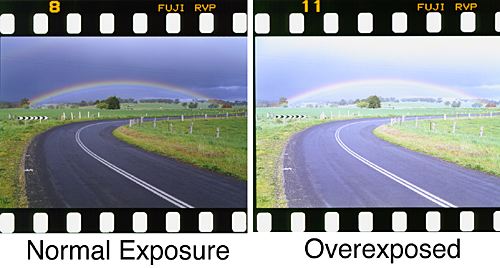
When we make a power measurement with some real detector, we get energy captured over some time interval. This is called exposure. For example, the response of a piece of film is proportional to the total energy received.
Example of exposure:
Radiant Flux
For example, we can say that a light source emits 50 watts of radiant power, or that 20 watts of radiant power is incident on a table.
Example of radiant power detector:
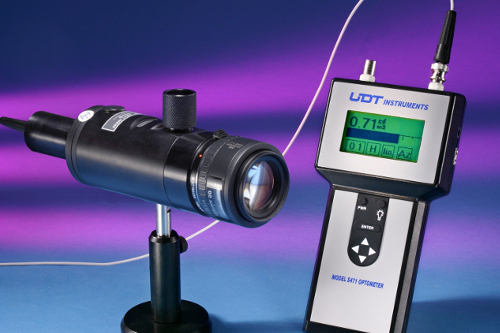
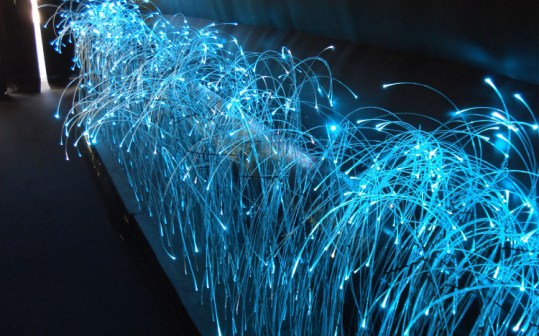
Example of radiation power emerging from the optical fiber:
Heat Loss
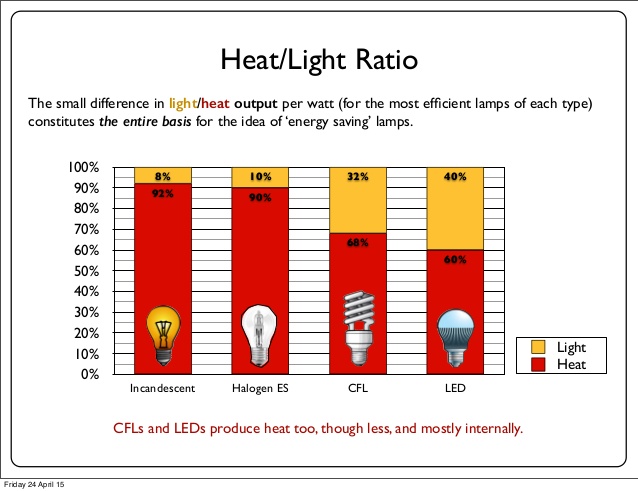
The units of power may be more familiar, for example, a 100-watt light bulb. Such bulbs draw approximately 100 J of energy each second. The power of the light produced will actually be less than 100 W because of heat loss, etc.
Example of heat/light ratio:
60W fluorescent tube and a 35W Xe arc-lamp
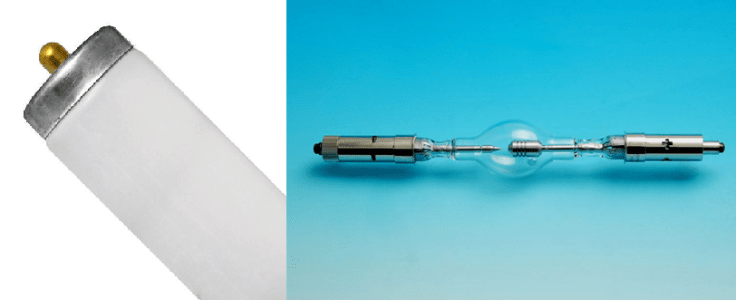
This unit is not helpful to determine whether a particular light source with a particular radiant flux will be useful in delivering its power to an optical instrument. For example, if we have a 60W fluorescent tube and a 35W Xe arc-lamp, then the fluorescent tube emits a greater radiant flux than the arc-lamp. But, with an appropiate focusing optic, the arc lamp will deliver a higher radiant flux emitted to a optical fiber.
Example 60W fluorescent tube and 35W Xe arc-lamp:
Point Light
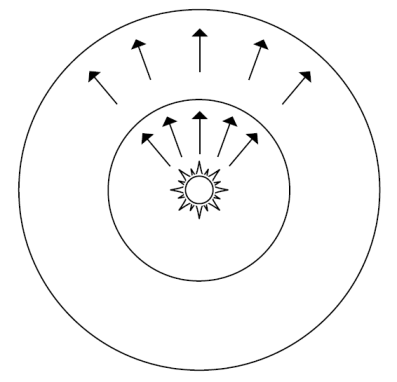
Total emission from light sources is generally described in terms of flux. For example, in a point light source you can measure the flux by the total amount of energy passing through an imaginary sphere around the light.
If you have two concentric spheres, the total flux measured will be the same, but less energy is passing through any local part of the large sphere than the small sphere, because the greater area of the large sphere means that the total flux is the same.
In the next post, we are going to talk about radiance.
References
Real-Time Rendering, 3rd Edition
Physically Based Rendering, 3rd Edition: From theory to implementation
Fundamentals of Computer Graphics, 4th Edition
Essential Mathematics for Games and Interactive Applications, 3rd Edition
Introduction to Computer Graphics: A Practical Learning Approach, 1st Edition
 Nicolás Bertoa